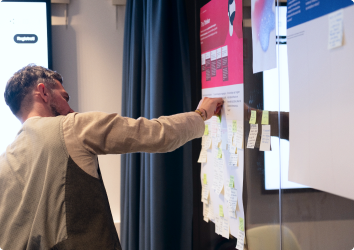
Shaping a conscious
and sustainable
AI transformation

We help organizations identify where AI creates real value, design trustworthy human–AI experiences, and measure their impact over time.

AI isometric illustration

Our framework
to design AI-based
services

We see AI as a socio-technical system that must be designed coherently across human, organizational and technological layers — in order to be successfully adopted and generate meaningful impact.
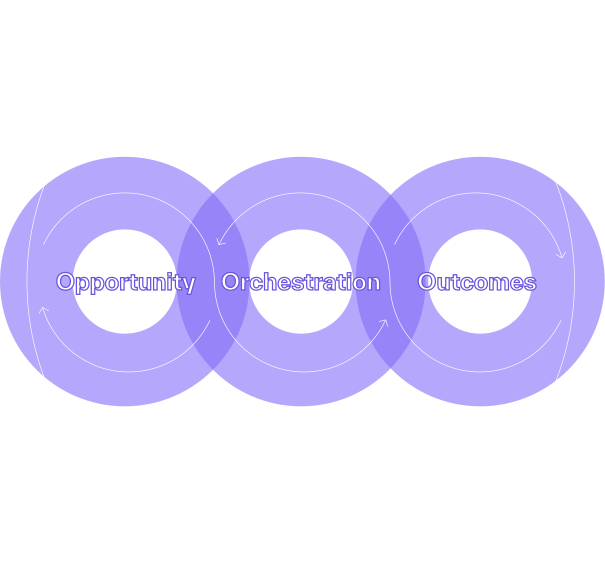
Triple-O framework diagram

Our Triple-O framework is built on years of hands-on experience designing AI-based services across industries.

It is structured around three phases — Opportunities, Orchestration, Outcomes — to help identify where AI can bring real value, design meaningful human–AI collaboration, and ensure responsible long-term impact.

It's an iterative loop, that considers desired outcomes since the beginning of any technical implementation.

Plan

Think before investing in AI

Where can AI create meaningful value?

Map your back-end processes and front-end service delivery to identify valuable opportunities for AI application — and build a clear, prioritized roadmap.

When is it worth investing and when to avoid it?

Understand the differentiating value that AI could bring in your context, and measure it against complexity and scale of implementation, to make informed strategic choices and start a process of AI transformation.

Methods and tools

  • Opportunity landscape
  • AI functionality cards
  • Prioritization matrix

Need help with AI strategy?

GET IN TOUCH

Design

Craft trustworthy AI experiences

How does AI fit into existing workflows?

AI should not be conceived as a tool to plug and play: any AI application should be thoughtfully integrated into existing processes, roles, and service touchpoints to be successfully adopted.

What is the best interaction paradigm?

Understanding the user perspective, priorities and mental model is essential to design AI interactions that feel natural, build trust, and generate real value rather than friction.

Methods and tools

  • Augmented-user
  • Human-AI experience map
  • Agent stories map

Want to improve your AI experiences?

GET IN TOUCH

Measure

Evaluate the AI performance

What are the desired outcomes you hope to achieve?

Setting clear impact goals since the beginning helps shape coherent AI solutions that are aligned with both business objectives and human needs.

How has AI been adopted and what's the value generated?

Collecting data about AI usage and impact on aspects such as individual productivity, team collaboration, and service quality enables informed iteration and responsible scaling.

Methods and tools

  • AI Impact map
  • Maturity model

Looking to measure AI impact?

GET IN TOUCH

Case Studies

Doctors Without Borders

Opportunities identification with Doctors Without Borders

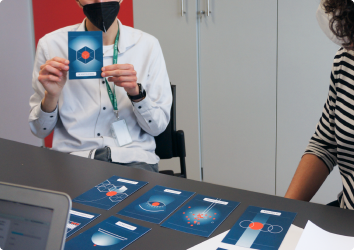
From uncertainty to 100+ AI ideas co-created across the organization — and a structured roadmap for conscious adoption. Using the Opportunity Landscape to map five main value chains, AI Functionality Cards to ideate solutions for them, and AI Prioritization Matrix to select what to implement in the next 3 years.

Indigo.AI

Orchestrating AI-agents implementation with Indigo.AI

Structuring internal ops to design AI-agents that align with both customers' and brands' needs. We empowered the Indigo.AI team with a methodology that allows them to identify and prioritize use-cases for the agent design (with the Use Cases Map), and to define specific features in terms of tone-of-voice and conversation style (with the Agent Identikit canvas).
Ammagamma

Outcomes measurements for an AI-based solution for Ammagamma

Developing a framework to understand the impact of an AI solution for inventory optimization — by reconstructing the full supply-chain map, identifying relevant indicators and combining qualitative and quantitative methods for data collection. The findings were synthesized into a AI Impact Map, that reveals both the value generated and new opportunities to consider.

AI Bootcamp

Want to apply it to your context?

Our bootcamps are the fastest way to get the structure and export support. Work directly with our team using tested tools and walk out with a clear picture of your next move. Each bootcamp can focus on any phase of the Triple-O framework — or span across all three.

For Professionals

AI bootcamp

A one-day intensive workshop to learn tools and methods that you can apply to your challenges.

  • Inspiration and mindset on how to approach AI consciously in your context
  • Consultancy from our experienced design leads, tailored to your specific situation
  • Practical fluency with our tested methodology and toolkit to use independently
  • Fresh perspectives from working alongside professionals from other industries and roles
  • 1 full day
  • up to 6 participants
  • @oblo studio in Milan
For Companies

Custom training

A tailored internal training to both align competences and work together on defined AI-related processes.

  • A bespoke bootcamp based on your maturity, needs, challenges and industry: could be related just to one part of the methodology or to the whole framework
  • Strategic advice without pushing for any particular solution (no specific tech sales)
  • A refined brief ready to kickstart an AI project or reshape existing initiatives
  • From 1 full day
  • up to 20 participants
  • @your offices or offsite
"The Augment / Assist / Automate framework let me rethink my entire design flow. If you focus on AI as a tool, you risk becoming obsolete in months. Focusing on decision-making frameworks, like oblo's tools, instead you get a flexible framework for the future challenges."
D
Davide Genco, Co-founder @ Experience Design Academy
"Bootcamp experience was fundamental in replicating the approach internally, involving different colleagues and creating real transformation opportunities for AI across our teams."
K
Karla Borda — Innovation, Transformation & Foresight, @Bocconi
"Since the bootcamp, integrating AI into our daily work has become more natural. I found that structured activities like those in the bootcamp made discussions much more productive. Compared to open-ended conversations, these exercises helped trigger more meaningful dialogue on how to engage with AI."
R
Ryohei Kawagishi — Service designer @Concent, Inc.

Trusted by

Lavazza
Bocconi
JP Morgan
Astrazeneca
Samsung
Cerved
Accenture
Indigo.AI
Médecins Sans Frontières
Metadonors
Polidesign

Find out more about our methods and stay up-to-date on any new development

Subscribe to our AI Lab newsletter for methodology deep-dives, detailed case studies, and new tools. You'll also get access to our comprehensive playbook on designing AI-based services — our full framework, tools, and principles in one place.

Oblo expertise

Applied ethnography

We apply design research to explore human behavior and collect data and stories that inspire meaningful innovation.

Systems thinking

We challenge assumptions to shape design interventions that match internal and external needs. We use visualization and sense-making to better navigate complexity, support organizational alignment and facilitate decision-making.

Co-design and prototyping

We transform ideas into tangible products and service experiences, enhancing both back-end and front-end processes.

Meet our AI experts

Yulya Besplemennova

Yulya Besplemennova

Partner & Complexity & Innovation Expert

Designer and researcher at the intersection of AI, systemic design, and service innovation. Since 2019, she has led oblo's AI-driven projects, synthesizing practical insights into actionable methods and canvases that make the complexity of AI accessible for designers and teams.

With over a decade of experience she worked with both public and private organizations — including the United Nations, Samsung, the Digital Transformation Team of Italian Government, City of Milan among many others, and taught in various university and other contexts.

Roberta Tassi

Roberta Tassi

Founder & design director

Expert experience and service designer, author of Service Design Tools. Previously, Principal Designer at frog (2010–2016) and Head of Service Design for the Italian Government's Digital Transformation Team (2017–2020). Professor of Interaction and Experience Design at Politecnico di Milano.

Throughout her career, Roberta has designed successful products, services and experiences for organizations such as Enel, Intesa Sanpaolo, Doctors Without Borders, PagoPA, Roche, Samsung and the United Nations.